JEV is INSANE It read 6,030 ChatGPT answers to buyer questions about 1,005 YC companies and checked every company name in every answer. 37,636 verdicts. 9.1M tokens. 40 seconds. $0.38. Grading the same 6,030 answers with Claude Sonnet cost me $36 last month. 71% of these startups were never named once, even when the buyer asked ChatGPT for exactly what they build. Scan your site and see if AI mentions you. Link in the first comment 👇
I asked Jev to predict its own future.
My last post (below) got 300k+ impressions, 400+ comments, 101 reposts.
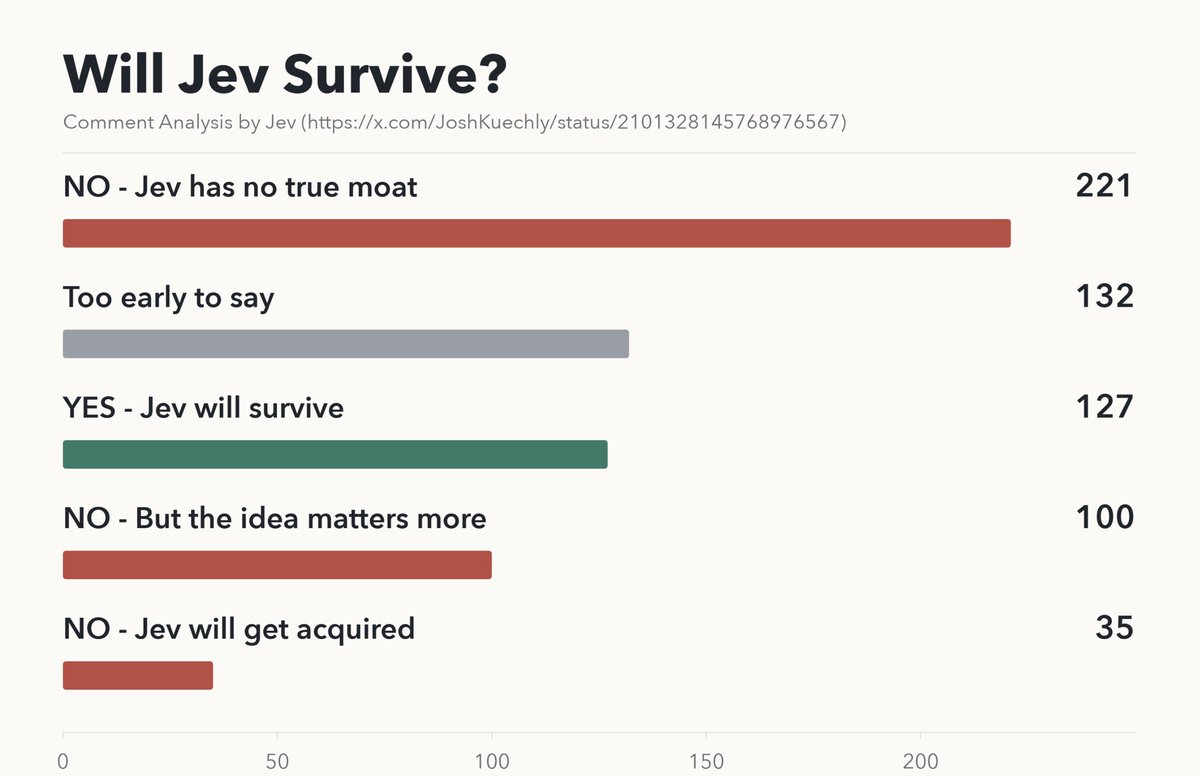
I used Jev to categorize every comment and quote to capture public X opinion on Jev’s future.
Here’s results:
————
*Note: I created five prediction buckets, plus an “other” bucket for comments that didn’t cleanly fit into any of the five, or didn’t contain any substantive text. I’ve excluded the “other” bucket in the chart below.
Also, for those who may wonder about the accuracy of using Jev for this, I made a second labeling pass with GPT 5.6 Sol. Jev and Sol agreed on ~8
turned the Constitution into a knowledge graph in 4s, the Odyssey in 45s. - per sentence, deterministically generates possible subject, predicates and objects. - used jev to sift through it all. result is very fast and cheap triple creation. https://t.co/vfFawqABOZhttps://t.co/pn0tphOAvI
Curating clinical variables from free-text notes is tedious. General LLMs can help, but processing thousands of notes can be slow and costly. Inspired by Jev and the open-source community, we’re releasing MedJev to turn clinical notes into structured fields on consumer GPUs. A 0.8B model + 43 MB LoRA adapter, trained to extract 11 predefined clinical variables. On our benchmark of 2,895 held-out n
We gave @typesafeai's Jev 1,968 live skincare & wellness ads and asked it 33 questions about each one. 64,944 typed answers. 36 seconds, real time, no cuts. 17 cents. Hook type, selling angle, creator-led or not, health claims that would need proof. Every ad, every question. What would you ask it?
0920X posts·Research & datacost17 centstime36 seconds, real timeOriginal source ↗
A really cool use case of how we use Jev to understand how people talk about Upstash This is 100% open-source too. Quick demo 👇 https://t.co/KlwpWJYsAH
If anyone ever says I don't ship, this is my SECOND launched product today! Introducing Built on the @typesafeai Jev model everyone's talking about. Input a CSV/Spreadsheet...ask a question about it, and Columns answers every row in seconds. Try it free. Shoutout to @AleksDoesCode for launch repo. I couldn't keep up with all the launches if it wasnt for that!
Using Jev for data sorting and analysis is something! Here it is structuring data from complaints filed via the Consumer Financial Protection Bureau API. Using an inexpensive, fast, probability LLM is going to upend so many of the resource intensive data activities we do. https://t.co/KVJFh9kNYO
ran a toy pipeline comparing jev vs codex luna as graders on FrontierCode style "code taste" tasks: decomposed text-based rubrics into structured answers (e.g. are all changes necessary? do all changes consistently use the abstractions required by the task?) -> run both models in parallel to compare accuracy, latency, cost jev got similar accuracy at <5% cost and <3% latency of luna (tiny sample.
1332X posts·Research & datacost<5% costtime<3% latency of lunaOriginal source ↗
I have been messing around with Jev @typesafeai and since it is a fast decision-making model thought it would be good to ask Codex to build a dataset of circle with defects where the Codex created challenging cases that stump a human and make them curious and be like: "if I don't get it, will an AI get it?" Codex @OpenAIDevs ran Jev on a 1000 sample dataset - it ran through the batch in 23s with 7
JEV invoice arbitrage is getting out of hand... Bookkeepers charge ~$0.50 per invoice for manual entry. JEV reads 1,000 invoices for $0.40. That's a 99.92% margin. Vendor, invoice no, dates, VAT, total, GL account. All 8 fields, ~2 seconds each, 6 workers in parallel Thanks for the opportunities, Typesafe! Accountants, I'm sorry
I built retrieval pipeline with Jev. It searches a SciFact corpus, evaluates the retrieved documents, selects up to five, and generates an answer from their contents. https://t.co/INrodePeNt
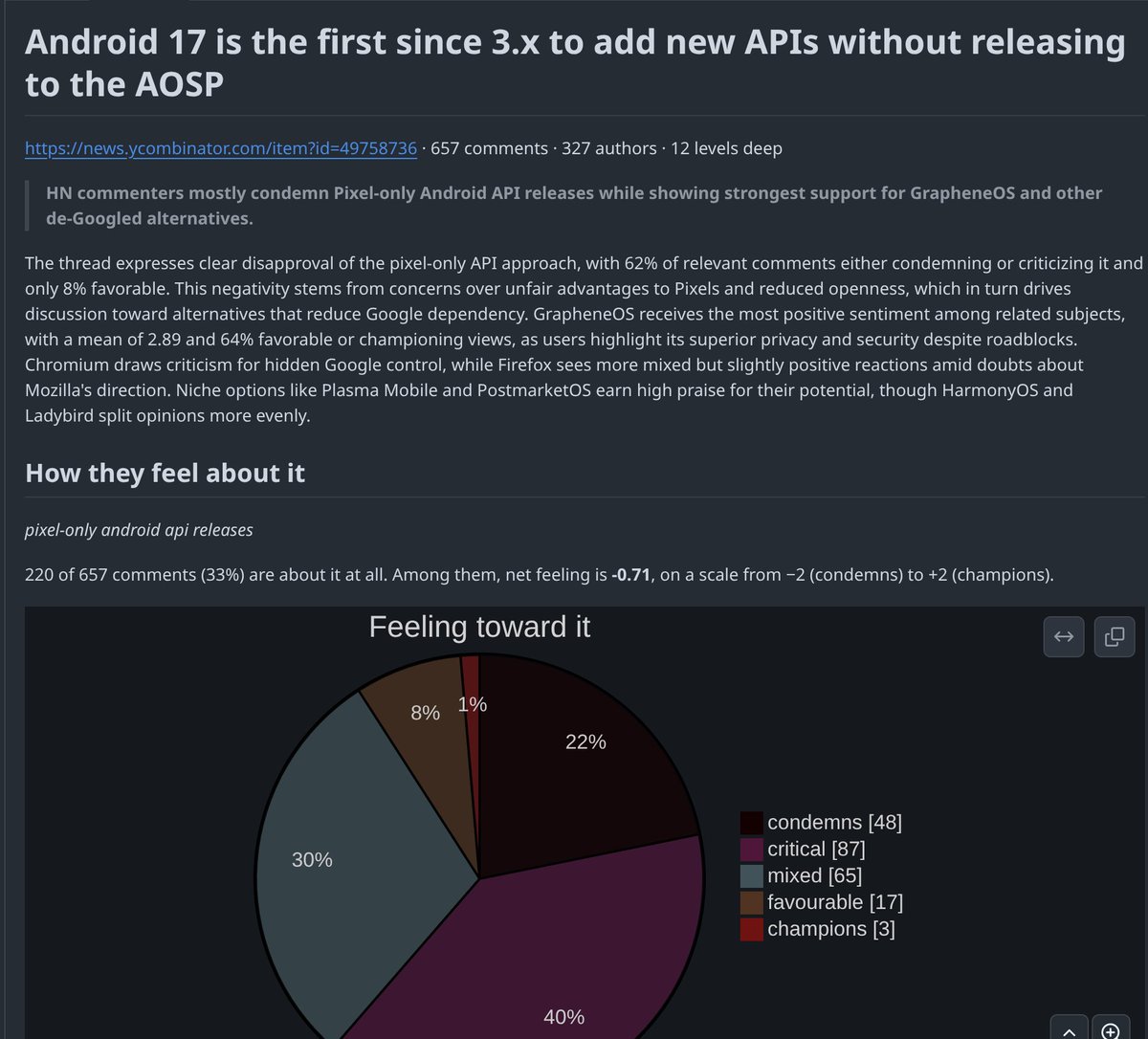
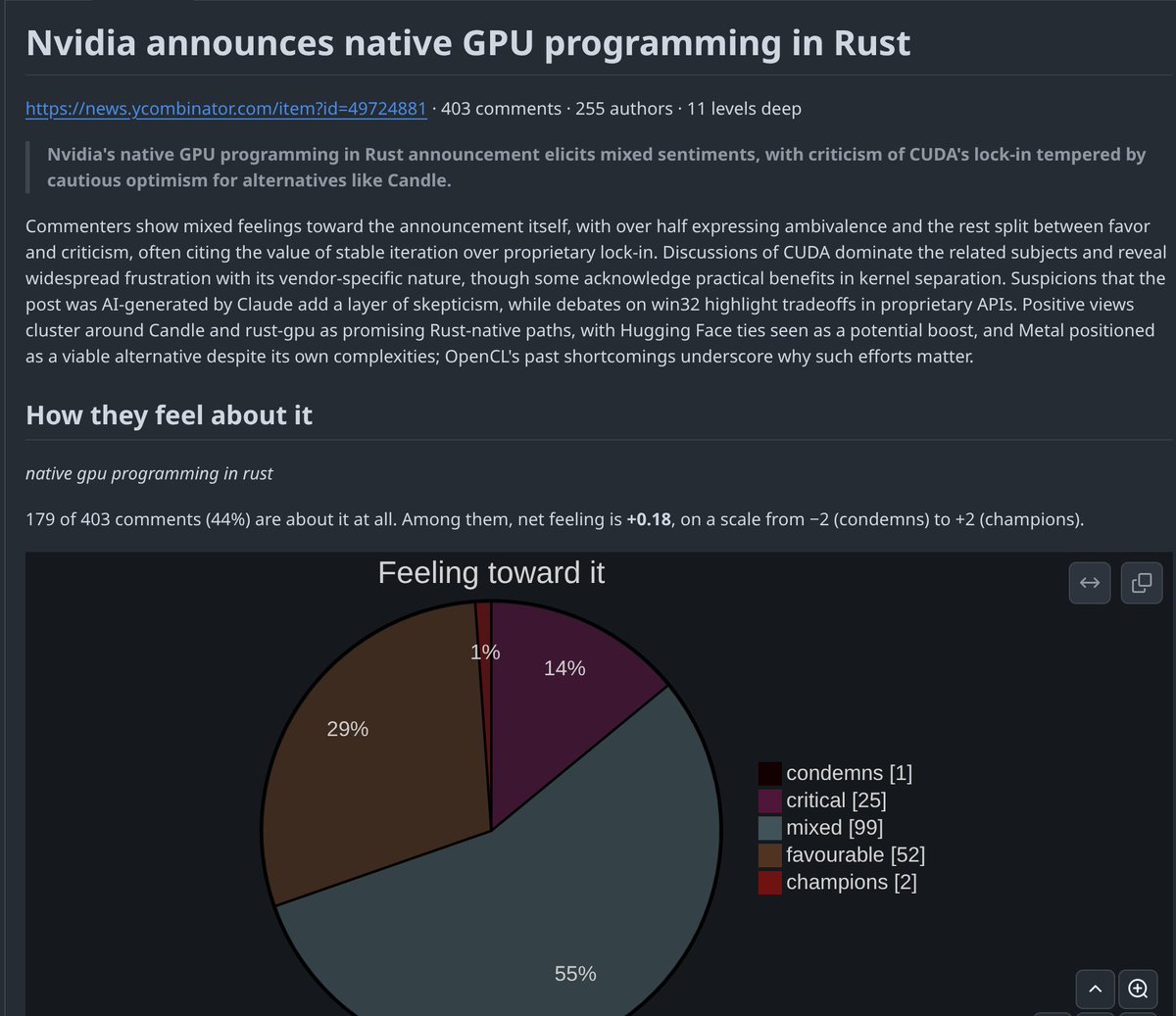
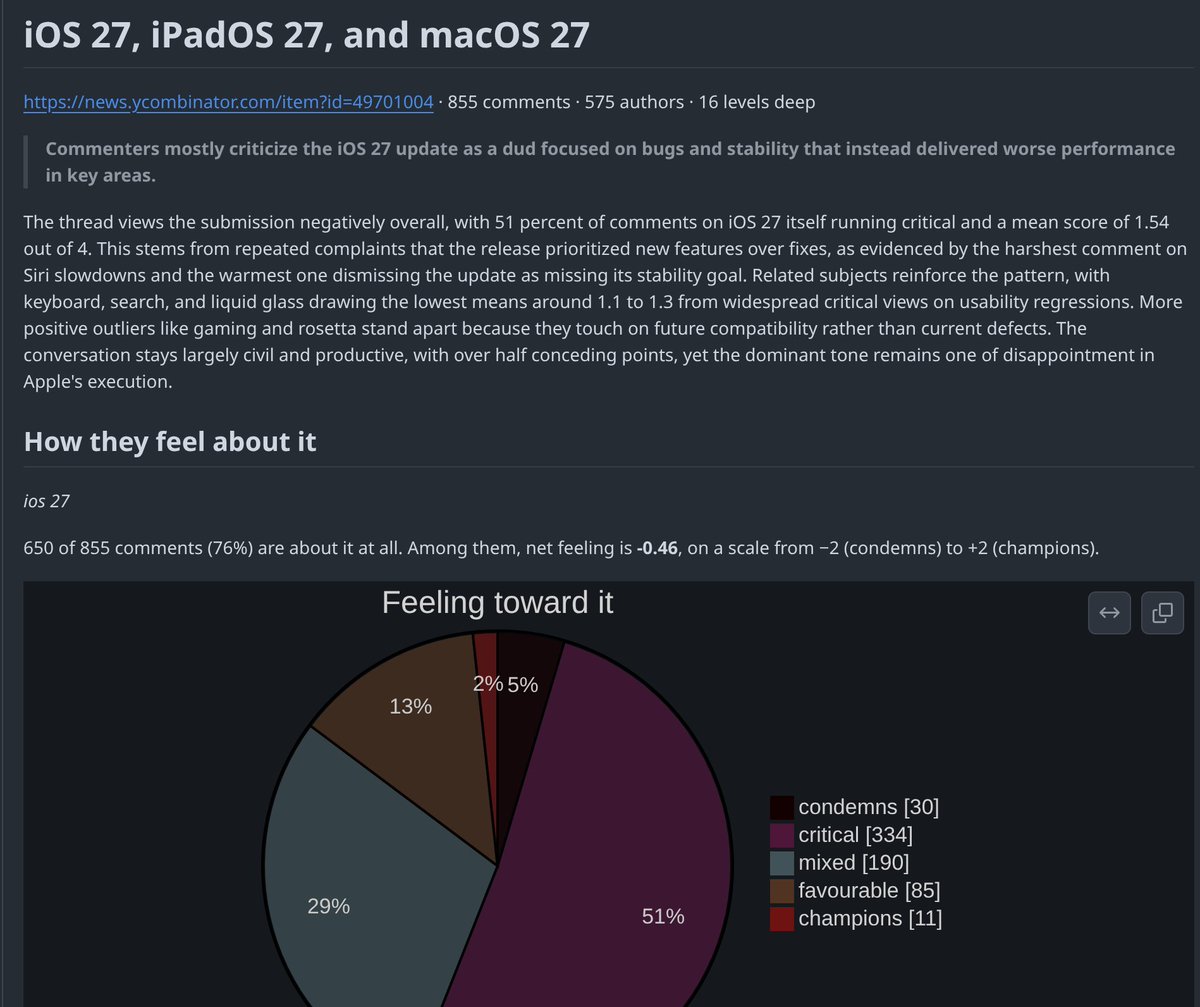
Had Jev (@typesafeai) read every comment on the most-discussed threads on Hacker News (@hackernews) and give a verdict ⚖️ → https://t.co/yNm3mmH737 • Every comment judged by Jev: stance (support / critical / neutral), a substance score, a 0..1 quotability, and whether it raises an open question • Verdict card is assembled deterministically • Live verdicts for not verdict-ed threads • Data & Search
My wiki search was picking the right answer 1 time in 3. I put Jev in front of it as a re-ranker — a typed decision, not another prompt. from 33% to 50%, at about $0.0005 and 550 ms per query. 12 queries. Small sample. Still the cheapest accuracy I've bought all week. https://t.co/Ny8qjl3X6w
1244X posts·Research & datacostabout $0.0005time550 ms per queryOriginal source ↗
Found a great production use case for Jev. I used Jev to organize ~2.3K AI research papers. The total cost was $0.14, and it took about 83 seconds. The process: The papers already had old tags, which I ran through a previous open model (DeepSeek V4 Flash). However, I wasn't confident in the classifications, and I didn't want to spend more on tokens unless I spent time tuning it into a good LLM cla
I built a tool powered by Jev that extracts any products features and business logic into a markdown repo Enter a product URL and you can copy features, ICP, messaging, pricing strategy, etc straight to a md file https://t.co/mS8CoBuk1x
JEV just audited 300 web pages for $0.02 🤯 Claude Opus 5, same pages, same 9 questions: $1.21 for the first 100. Per page: 61 ms against 2.8 seconds. What Jev hands back for every page: → the page type, sorted into 7 bins → 8 yes/no checks an AI assistant runs before it cites you → a citability score and a fix list Same output? Opus 5 graded 900 of Jev's decisions. 85.8% match. The twist: 122 of t
1059X posts·Research & datacost$0.02time61 ms against 2.8 seconds.Original source ↗
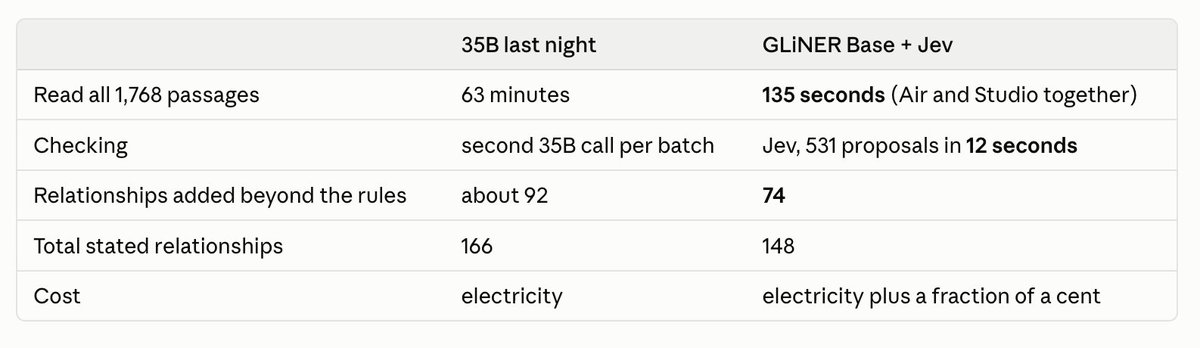
First real use case with Jev got up and running last night.
Used it with GLiNER 2.5 base to help dramatically speed up entity / relationship extraction.
GLiNER by itself for Graph RAG over a huge document corpus is fairly unreliable. Using Jev to help determine what it got right and then send everything else to my local 35B model.
~25x performance boost.
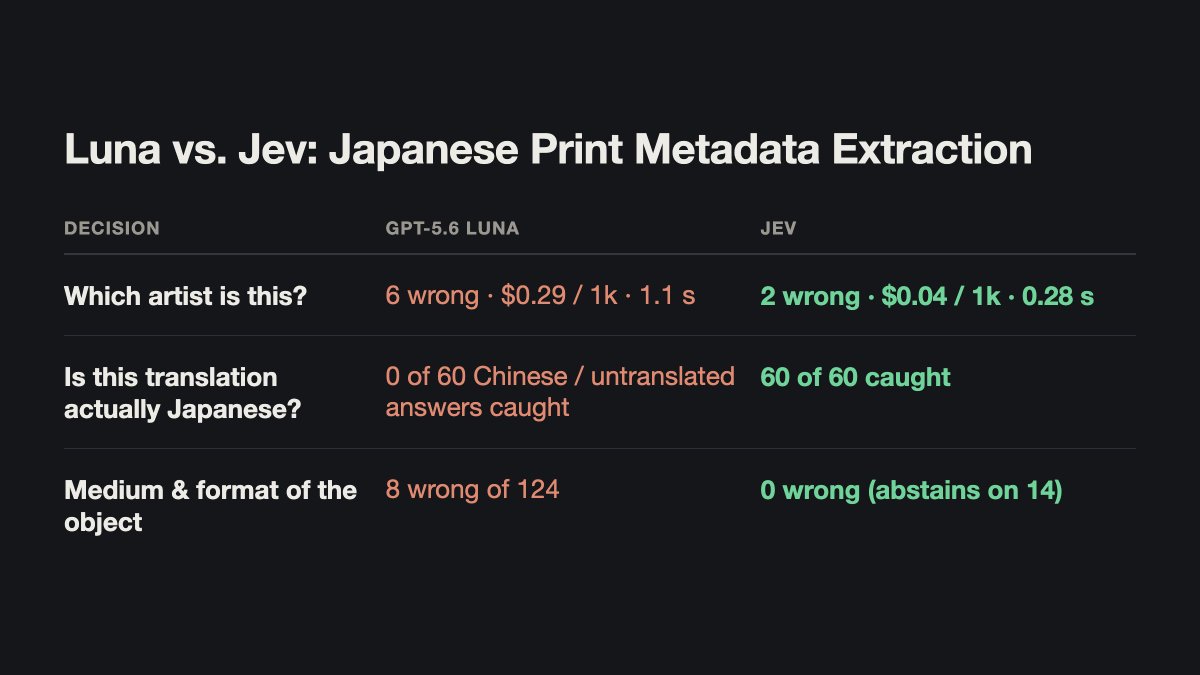
I just had to explore using Jev with my existing Japanese print metadata extraction pipeline (where I use gpt-5.6 luna). Turns out that in some cases I could replace luna completely and save a bunch of money - in others I could augment what I had for higher quality! https://t.co/iSFOGPJjf8
 devwithjev